EIR (EQUIPMENT IDENTITY REGISTER)
Enhance Your Network Security with EIR (Equipment Identity Register)
Mobile communications are no longer limited to voice services, but also include data and multimedia. To maximize these services, operators use IMEI (Device Identity) and IMSI (Subscriber Identity) to identify device types and users. The combination of both allows services to be tailored to the capabilities of the device. In GSM networks, IMEI and IMSI data are sent via the Gf interface, allowing operators to access this information efficiently for optimal service delivery.

Objective
The purpose of this solution is to provide a server that can mimic the EIR function in capturing IMEI and IMSI information in the Gf interface and then send it to another server specified by Celcom via FTP (File Transfer Protocol) on the IP network.
EIR (EQUIPMENT IDENTITY REGISTER)
The Equipment Identity Register is a database used in cellular networks. This database stores records for three types of mobile phones: black, gray, and white.
When a mobile phone requests service from the network, its IMEI (International Mobile Equipment Identity) can be checked with the EIR to assess the category of the mobile phone. Black mobile phones are mobile phones that have been reported stolen or whose operation on the network will have a negative impact on network operations. These mobile phones will not be allowed to access the network. Gray phones are classified as non-compliant but can be used on the network. White phones are phones that comply with the requirements set by the network operator.
Typically, the EIR is connected to the SGSN (Serving GPRS Support Node) via a Gf interface. The SGSN will send a MAP message containing information about the IMEI and IMSI of the phone user each time the phone user starts using the GPRS network.

TEL-ACCESS MAP SERVER
The Tel-Access EIR solution is based on the Tel-Access MAP Server. The Tel-Access MAP Server is a specialized in-the-box solution that provides a standalone external GSM MAP (Mobile Application Part) signaling unit.
The Tel-Access MAP Server is a Solaris or Linux Server with the Telesoft SS7/Sigtran stack with MAP protocol and Oracle database engine. This system is designed as an open platform using industry standard components to make it easier to connect to other devices in the future. Since this solution is a computer-based solution, it can also be customized to suit the needs of the operator.
SYSTEM ARCHITECTURE
The EIR system consists of two main components, as follows
Sigtran Server
A server that handles Sigtran data communication. This server will connect to the STP and handle MAP communication via Sigtran to obtain information from the SGSN.
Information retrieved from the Sigtran Protocol will be stored in the database system on the Data Server for further processing.
Data Server
A server that handles the database system to manage information captured by the Sigtran Server. The Data Server also has several applications that serve to transfer information to the DMS.
Two Data Servers will be implemented to provide redundancy so that if one server fails, the other server can still handle data processing functions.
Data Flow
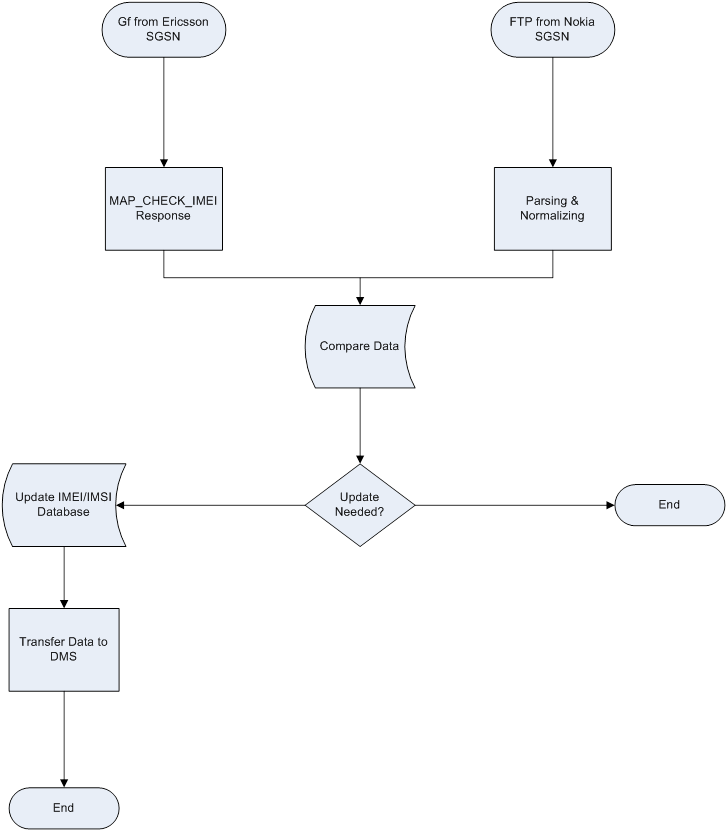
Information retrieved from SGSN via MAP protocol messages and via FTP. All IMEI and IMSI information retrieved will be processed by the data processing application to determine whether the IMEI and IMSI information is already stored in the database.
If the IMEI and IMSI are already in the database, the data processing application will ignore the information because there is no need to process the data further since it is already stored in the database.
If the data processing application finds that the IMEI and IMSI information is not in the database, the system will insert the IMEI and IMSI into the database table and then send the data row to the DMS using FTP.
Here are some advantages of Tel-Access MAP Server:
1. Open Platform, this solution can be connected and integrated with other devices whenever needed because it is based on an industry-standard server with TCP/IP connection and Solaris or Linux operating system.
2. Based on Telesoft Technologies SS7/Sigtran stack. Telesoft Technologies is a leader in SS7 stacks and mobile network protocols with implementations worldwide.
3. Customizable. Tel-Access MAP Server has an API as a programmable interface so that this solution can be customized to user needs.
4. Local Support. Tel-Access provides local support and technical services so that users can be supported locally for faster problem resolution.